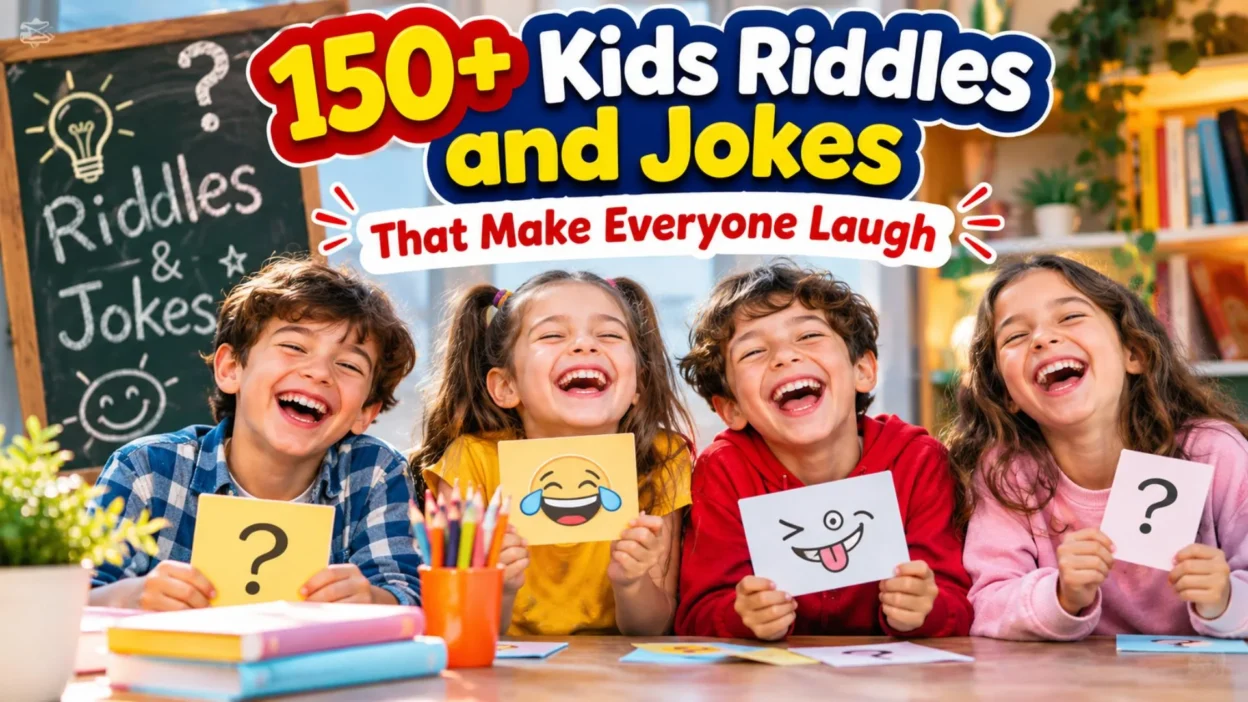
Looking for fun kids riddles and jokes that bring smiles to little faces? You’re in the right place! Riddles and jokes are a wonderful way to keep children entertained while helping them think, learn, and use their imagination. Whether you need a fun activity for a family night, a classroom break, or a long car ride, these clever questions and funny punchlines will make everyone laugh.
Moreover, children love solving little mysteries and sharing silly jokes with their friends. Some riddles are easy enough for toddlers, while others offer a fun challenge for older kids. Likewise, these jokes include funny animals, tasty foods, school moments, and playful surprises. So, gather the kids, read each question aloud, and see who can guess the answer first!
Best Kids Riddles and Jokes
The best riddles combine simple clues with surprising answers. As a result, children can enjoy the challenge without feeling confused. These questions are great for family gatherings, classroom games, and everyday fun.
Here are some entertaining riddles to get everyone started:
- What has hands but cannot clap? Answer: A clock.
- What has a face and two hands but no arms or legs? Answer: A clock.
- What gets wetter the more it dries? Answer: A towel.
- What has many teeth but cannot bite? Answer: A comb.
- What has one eye but cannot see? Answer: A needle.
- What goes up but never comes down? Answer: Your age.
- What has a neck but no head? Answer: A bottle.
- What can travel around the world while staying in one corner? Answer: A stamp.
- What has four legs but cannot walk? Answer: A table.
- What has words but never speaks? Answer: A book.
- What has a bottom at the top? Answer: Your legs.
- What can you catch but cannot throw? Answer: A cold.
- What has keys but cannot open any doors? Answer: A piano.
- What runs but never walks? Answer: Water.
- What has a ring but no finger? Answer: A telephone.
These classic riddles are easy to remember. Therefore, kids can quickly learn them and share them with friends.
Easy Riddles for Kids
Easy riddles are perfect for younger children who are just discovering wordplay. In addition, they help kids recognize familiar objects and think about them in different ways.
Try these simple questions with your little ones:
- What is orange and sounds like a parrot? Answer: A carrot.
- What has ears but cannot hear? Answer: Corn.
- What has a head and a tail but no body? Answer: A coin.
- What is full of holes but still holds water? Answer: A sponge.
- What has four wheels and flies? Answer: A garbage truck.
- What can fill a room but takes up no space? Answer: Light.
- What has a bed but never sleeps? Answer: A river.
- What has branches but no leaves? Answer: A bank.
- What goes through cities and fields but never moves? Answer: A road.
- What is always in front of you but cannot be seen? Answer: The future.
- What has a thumb and four fingers but is not alive? Answer: A glove.
- What begins with T, ends with T, and has T inside? Answer: A teapot.
- What has a tongue but cannot talk? Answer: A shoe.
- What kind of room has no doors or windows? Answer: A mushroom.
- What gets bigger when you take something away from it? Answer: A hole.
These easy riddles are especially useful for quick games. For example, parents can ask one question at breakfast or let children take turns asking them during playtime.
Funny Riddles for Kids
Funny riddles make children laugh because their answers are often unexpected. Sometimes, the funniest part is the silly picture that pops into a child’s mind.
Here are some hilarious riddles to brighten the day:
- Why did the banana go to the doctor? Answer: Because it wasn’t peeling well!
- What do you call a sleeping dinosaur? Answer: A dino-snore!
- Why did the teddy bear skip dessert? Answer: Because it was stuffed!
- What has four wheels and eats people? Answer: A monster truck!
- Why did the math book look so sad? Answer: Because it had too many problems.
- What do you call a bear with no teeth? Answer: A gummy bear.
- Why did the cookie go to the hospital? Answer: Because it felt crummy.
- What kind of tree can fit in your hand? Answer: A palm tree.
- Why did the bicycle fall over? Answer: Because it was two-tired!
- What do you call a funny mountain? Answer: Hill-arious!
- Why did the student eat his homework? Answer: Because the teacher said it was a piece of cake!
- What do you call a pig that knows karate? Answer: A pork chop!
- Why was the broom late? Answer: It swept in!
- What do you call cheese that isn’t yours? Answer: Nacho cheese!
- Why did the orange stop rolling? Answer: Because it ran out of juice!
Share these funny questions at home or during a school break. Even better, ask children to explain why the answers are funny. This makes the game more interactive.
Animal Riddles for Kids
Animals are a favorite subject for children. From playful puppies to mighty lions, kids enjoy guessing which creature is hiding behind each clue.
Furthermore, animal riddles can help children remember animal names and learn about their features.
- I have a long neck and eat leaves from tall trees. What am I? Answer: A giraffe.
- I say “meow” and love chasing mice. What am I? Answer: A cat.
- I have a mane and am known as the king of the jungle. What am I? Answer: A lion.
- I have black and white stripes. What am I? Answer: A zebra.
- I carry my home on my back and move very slowly. What am I? Answer: A snail.
- I have a pouch where my baby can ride. What am I? Answer: A kangaroo.
- I can change my color to blend into my surroundings. What am I? Answer: A chameleon.
- I have eight legs and make webs. What am I? Answer: A spider.
- I live in cold places and cannot fly, but I can swim. What am I? Answer: A penguin.
- I have a trunk but no suitcase. What am I? Answer: An elephant.
- I hop around and have long ears. What am I? Answer: A rabbit.
- I produce honey and buzz around flowers. What am I? Answer: A bee.
- I am called man’s best friend and love to bark. What am I? Answer: A dog.
- I have a shell and walk very slowly. What am I? Answer: A turtle.
- I can mimic human speech and have colorful feathers. What am I? Answer: A parrot.
For an extra challenge, let children make their own animal riddles. They can choose an animal, describe its appearance, and let everyone guess the answer.
Food Riddles for Kids
Food riddles turn everyday snacks and meals into a fun guessing game. In addition, they introduce children to different foods through simple clues and playful word choices.
Read these tasty riddles and see who gets the answers right!
- I am yellow, curved, and monkeys love me. What am I? Answer: A banana.
- I am round, red, and often used in salads. What am I? Answer: A tomato.
- I have layers and can make you cry when you cut me. What am I? Answer: An onion.
- I am cold, sweet, and come in many flavors. What am I? Answer: Ice cream.
- I have a hard shell and a sweet, juicy inside. What am I? Answer: A coconut.
- I am a fruit with seeds on the outside. What am I? Answer: A strawberry.
- I am long, orange, and rabbits love to eat me. What am I? Answer: A carrot.
- I pop when I get hot and make a crunchy snack. What am I? Answer: Popcorn.
- I am round, cheesy, and often cut into slices. What am I? Answer: Pizza.
- I have a yellow outside and a sweet, juicy inside. What am I? Answer: A pineapple.
- I am small, round, and grow in bunches. What am I? Answer: Grapes.
- I am baked in an oven and often have chocolate chips. What am I? Answer: A cookie.
- I am a breakfast food that comes from chickens. What am I? Answer: An egg.
- I am white, cold, and often served in a glass. What am I? Answer: Milk.
- I am a sweet treat that can have candles on top. What am I? Answer: A birthday cake.
You can also use these riddles during lunch or snack time. For instance, ask a question before serving a meal and let everyone guess the answer.
School Riddles for Kids
School is full of books, pencils, teachers, and exciting lessons. Therefore, school-themed riddles are a great choice for classroom activities and study breaks.
These questions bring a little humor into everyday learning:
- I have many pages but cannot speak. What am I? Answer: A textbook.
- I help you write but disappear as you use me. What am I? Answer: A pencil.
- I have a face and hands, and I tell you when class begins. What am I? Answer: A clock.
- I am full of letters but cannot read. What am I? Answer: A keyboard.
- I erase mistakes but never make them. What am I? Answer: An eraser.
- I have a board, but I am not a game. What am I? Answer: A classroom whiteboard.
- I carry books on my back but have no shoulders. What am I? Answer: A schoolbag.
- I am used to draw straight lines. What am I? Answer: A ruler.
- I ring to tell students when it is time to leave. What am I? Answer: A school bell.
- I have numbers and buttons and help you solve math problems. What am I? Answer: A calculator.
- I am a place where students borrow books. What am I? Answer: A library.
- I help you color pictures and come in many shades. What am I? Answer: Crayons.
- I hold your papers together but am not glue. What am I? Answer: A paper clip.
- I am where students sit while learning. What am I? Answer: A school desk.
- I give students knowledge but do not take a test. Who am I? Answer: A teacher.
Teachers can use these questions as warm-up activities. Similarly, parents can ask them after school to make learning conversations more enjoyable.
Hard Riddles for Older Kids
Some children enjoy a bigger challenge. For that reason, these tricky riddles are ideal for older kids who love solving puzzles and thinking carefully.
Encourage everyone to take their time. After all, the first answer that comes to mind is not always correct!
- The more you take, the more you leave behind. What are they? Answer: Footsteps.
- I speak without a mouth and hear without ears. I have no body, but I come alive with sound. What am I? Answer: An echo.
- What disappears as soon as you say its name? Answer: Silence.
- A man is outside in the rain without an umbrella or hat, but not a single hair on his head gets wet. Why? Answer: He is bald.
- What belongs to you but other people use it more than you do? Answer: Your name.
- What can be broken without being touched? Answer: A promise.
- What has cities, roads, and rivers but no people, cars, or water? Answer: A map.
- If you have me, you want to share me. If you share me, you no longer have me. What am I? Answer: A secret.
- What can run around a yard without moving? Answer: A fence.
- What has 13 hearts but no other organs? Answer: A deck of cards.
- What comes once in a minute, twice in a moment, but never in a thousand years? Answer: The letter M.
- What has an end but no beginning, a home but no family, and a space but no room? Answer: A keyboard.
- What can you hold in your left hand but not in your right hand? Answer: Your right elbow.
- What gets sharper the more you use it? Answer: Your brain.
- I am always hungry and must be fed, but water makes me die. What am I? Answer: Fire.
These challenging riddles are perfect for friendly competitions. However, give younger children a few hints if they get stuck. That way, everyone can enjoy the activity.
Knock-Knock Jokes for Kids
Knock-knock jokes are easy to learn and even easier to share. Their simple question-and-answer format makes them perfect for children who want to tell jokes to family members or friends.
Here are some clean and silly knock-knock jokes:
- Knock, knock. Who’s there? Lettuce. Lettuce who? Lettuce in! It’s cold outside!
- Knock, knock. Who’s there? Cow says. Cow says who? No, a cow says moo!
- Knock, knock. Who’s there? Tank. Tank who? You’re welcome!
- Knock, knock. Who’s there? Boo. Boo who? Don’t cry! It’s only a joke!
- Knock, knock. Who’s there? Olive. Olive who? Olive you!
- Knock, knock. Who’s there? Nobel. Nobel who? No bell, so I knocked!
- Knock, knock. Who’s there? Harry. Harry who? Harry up! Open the door!
- Knock, knock. Who’s there? Atch. Atch who? Bless you!
- Knock, knock. Who’s there? Annie. Annie who? Annie body home?
- Knock, knock. Who’s there? Donut. Donut who? Donut forget to smile!
- Knock, knock. Who’s there? Ice cream. Ice cream who? Ice cream whenever I see a spider!
- Knock, knock. Who’s there? Figs. Figs who? Figs the doorbell, please!
- Knock, knock. Who’s there? Owls. Owls who? Yes, they do!
- Knock, knock. Who’s there? Alpaca. Alpaca who? Alpaca the suitcase. You load the car!
- Knock, knock. Who’s there? Justin. Justin who? Justin time for dinner!
Let kids practice telling these jokes with funny voices and dramatic pauses. As a result, even a simple punchline can become a memorable performance.
Short One-Line Riddles for Kids
Sometimes, children want a quick question instead of a long puzzle. In that case, one-line riddles are a great option. They are easy to read, remember, and share.
Try these quick brain teasers:
- What has a bark but no bite? Answer: A tree.
- What has wings but cannot fly? Answer: A building.
- What is black and white and read all over? Answer: A newspaper.
- What has a crown but is not a king? Answer: A pineapple.
- What can jump higher than a house? Answer: Anything that can jump, because houses cannot jump.
- What has a spine but no bones? Answer: A book.
- What has a mouth but never eats? Answer: A river.
- What has a foot but no toes? Answer: A ruler.
- What is easy to lift but hard to throw? Answer: A feather.
- What can you serve but never eat? Answer: A tennis ball.
- What has a lot of eyes but cannot see? Answer: A potato.
- What has a head but no brain? Answer: A cabbage.
- What has no life but can still die? Answer: A battery.
- What has a heart that does not beat? Answer: An artichoke.
- What can you make that nobody can see? Answer: Noise.
These short riddles work well during quick breaks. Additionally, they are useful for car journeys, waiting rooms, and family dinners.
Silly and Clean Jokes for Kids
A good joke does not need rude words or complicated stories. Instead, simple wordplay and silly situations can make children laugh out loud.
Here are some clean jokes that kids can enjoy anywhere:
- Why don’t eggs tell jokes? Because they might crack up!
- What do you call a fake noodle? An impasta!
- Why did the golfer bring two pairs of pants? In case he got a hole in one!
- What do you call a dinosaur that crashes its car? Tyrannosaurus wrecks!
- Why can’t your nose be 12 inches long? Because then it would be a foot!
- What did one wall say to the other wall? I’ll meet you at the corner!
- Why did the computer go to the doctor? Because it had a virus!
- What do you call a sleeping bull? A bulldozer!
- Why did the tomato turn red? Because it saw the salad dressing!
- What kind of shoes do frogs wear? Open-toad sandals!
- Why was the music teacher so good at baseball? Because she had perfect pitch!
- What do you call a fish wearing a bow tie? Sofishticated!
- Why did the student bring a ladder to school? Because they wanted to go to high school!
- What do you call a cold dog sitting outside? A chili dog!
- Why did the scarecrow win an award? Because he was outstanding in his field!
These jokes are short enough for children to memorize. So, encourage them to choose their favorites and share one joke each day.
Creative Riddles That Make Kids Think
Creative riddles encourage children to look beyond obvious answers. They also help kids explore language, patterns, and everyday situations in a playful way.
The following questions offer a little extra thinking time:
- I have no legs, but I can move. I have no mouth, but I can roar. What am I? Answer: A waterfall.
- I am made before you can see me, and I disappear when you use me. What am I? Answer: A plan.
- I can be long or short, and I can be told or broken. What am I? Answer: A story.
- I have a thousand needles but cannot sew. What am I? Answer: A pine tree.
- I follow you during the day but disappear in the dark. What am I? Answer: Your shadow.
- I have no wings, but I can fly. I have no eyes, but I can cry. What am I? Answer: A cloud.
- I can be opened, closed, and shared, but I am not a door. What am I? Answer: A book.
- I am always moving, yet I stay in the same place. What am I? Answer: A clock’s hands.
- I have a beginning and an end, but I can go on forever in your imagination. What am I? Answer: A story.
- I can be heard but never seen. I can be loud or soft. What am I? Answer: A sound.
- I have many colors and appear after rain, but you cannot touch me. What am I? Answer: A rainbow.
- I grow smaller every time I take a bath. What am I? Answer: A bar of soap.
- I can be cracked, told, and played, but I am not a game. What am I? Answer: A joke.
- I am always coming but never arrive. What am I? Answer: Tomorrow.
- I can be written, spoken, and remembered. What am I? Answer: A word.
For an added challenge, ask children to create a different answer that still fits a clue. This activity encourages creative thinking and makes the game even more exciting.
How to Make Riddles and Jokes More Fun for Kids
Reading riddles is entertaining, but turning them into a game makes the experience even better. Fortunately, you do not need special equipment or expensive toys. A little imagination is enough to create a fun activity at home or school.
Here are some simple ways to make the experience more exciting.
1. Organize a Family Riddle Contest
First, gather everyone in one room and choose a person to read the riddles. Each correct answer earns one point. However, give everyone a fair chance to answer before moving to the next question.
At the end, count the points and celebrate the winner. You can also give a small prize, such as choosing the next family game.
2. Play a Classroom Guessing Game
Teachers can write riddles on a board and let students raise their hands to answer. In addition, students can work in small teams and discuss possible answers.
This activity encourages teamwork. It also gives shy children a chance to participate with their classmates.
3. Create a Joke-Telling Challenge
Ask every child to choose a clean joke and practice telling it. Then, let each person perform in front of the family or class.
Encourage funny expressions, pauses, and different voices. Afterward, everyone can vote for the funniest performance.
4. Use Riddles During Road Trips
Long car journeys can become boring for children. Therefore, parents can ask short riddles to keep everyone entertained.
Take turns asking questions so that every passenger gets a chance to participate. Just remember to keep the game relaxed and avoid distracting the driver.
5. Make Your Own Riddle Cards
Write one riddle on the front of a small card and its answer on the back. Next, place all the cards in a box and let children pick one at random.
You can even separate the cards into easy, medium, and hard categories. This makes the game suitable for different ages.
Benefits of Riddles and Jokes for Children
Riddles and jokes are more than simple entertainment. When children enjoy them regularly, these activities can support several useful skills.
However, every child learns differently. Therefore, treat riddles as a playful activity rather than a test.
They Encourage Critical Thinking
Riddles ask children to examine clues and connect different ideas. As a result, kids learn to think carefully before choosing an answer.
Even a simple question can encourage a child to consider more than one possibility.
They Build Vocabulary
Many riddles use familiar words in surprising ways. Consequently, children can discover new meanings and become more comfortable with language.
Parents can also explain unfamiliar words after each question.
They Improve Listening Skills
Children need to listen carefully to understand a riddle. If they miss an important clue, they may choose the wrong answer.
For this reason, riddles can encourage attention and active listening.
They Support Social Interaction
Sharing jokes gives children a reason to talk, laugh, and connect with others. Moreover, taking turns teaches patience and respectful communication.
These activities can be especially enjoyable during family gatherings and classroom breaks.
They Make Learning Enjoyable
A playful question can make an ordinary lesson more interesting. For example, teachers can use animal riddles during science lessons or number puzzles during math activities.
In this way, children can enjoy learning while exploring new ideas.
Tips for Choosing Age-Appropriate Riddles and Jokes
Not every riddle is suitable for every child. Some questions use simple words, while others depend on wordplay or abstract thinking.
Therefore, choose questions that match the child’s age, vocabulary, and interests.
For Toddlers and Preschoolers
Younger children usually enjoy short questions about familiar objects. Choose riddles about animals, colors, toys, food, and everyday items.
Also, use simple language and offer clues when needed. Most importantly, focus on having fun instead of getting every answer right.
For Children Ages 5 to 8
Children in this age group can enjoy simple wordplay and slightly trickier questions. For example, try riddles about school supplies, animals, and common household objects.
You can also introduce knock-knock jokes because their repeated format is easy to follow.
For Children Ages 9 to 12
Older kids may enjoy puzzles that require more thought. Try questions about patterns, words, logic, and unexpected answers.
Additionally, encourage them to write their own riddles. This gives them an opportunity to use their creativity and problem-solving skills.
Keep the Content Positive and Clean
Always choose jokes that are friendly and suitable for children. Avoid humor that makes fun of someone’s appearance, background, abilities, or feelings.
Instead, focus on harmless surprises, silly situations, and clever wordplay.
Frequently Asked Questions
1. What are the best riddles for kids?
The best riddles for kids are simple, funny, and easy to understand. Questions about animals, food, school supplies, and everyday objects are excellent choices. However, older children may enjoy harder riddles that require logical thinking.
2. Why are riddles good for children?
Riddles encourage children to think carefully, understand clues, and explore different answers. They can also support vocabulary development and listening skills. Most importantly, they make learning feel like a game.
3. What are some easy riddles for 5-year-olds?
Easy riddles for 5-year-olds include questions about familiar things. For example, ask, “What has four legs but cannot walk?” The answer is a table. You can also use questions about cats, dogs, bananas, and toys.
4. How can I make riddles fun for a classroom?
You can turn riddles into a team competition. Divide students into small groups, read one question at a time, and award points for correct answers. Additionally, let students create their own riddles for classmates to solve.
5. What are the funniest jokes for kids?
Funny kids’ jokes often use simple wordplay and silly situations. Examples include jokes about bananas, dinosaurs, cookies, animals, and school. Clean knock-knock jokes are also popular because children can easily remember and share them.
6. Are knock-knock jokes suitable for young children?
Yes, most clean knock-knock jokes are suitable for young children. Their repeated format makes them easy to understand and remember. Furthermore, children can practice telling them with funny voices and expressions.
7. How do I teach my child to create riddles?
Start by asking your child to choose a familiar object, such as an apple, pencil, or ball. Next, encourage them to describe its color, shape, purpose, or features without naming it. Finally, turn those clues into a question and let someone guess the answer.
8. Can riddles help children improve their vocabulary?
Yes, riddles can introduce children to new words and different meanings. In addition, they encourage kids to understand clues and think about how language works. Parents can explain unfamiliar words to make each activity more useful.
9. What is the difference between a riddle and a joke?
A riddle is a question or puzzle that asks someone to discover an answer. In contrast, a joke is a funny statement or story designed to make people laugh. Some riddles are also funny because their answers contain unexpected wordplay.
10. How many riddles should I ask my child at once?
There is no fixed number. You can start with three to five riddles and see how your child responds. If they enjoy the activity, continue with more questions. Remember to keep the experience relaxed and enjoyable.
Conclusion
Kids riddles and jokes are a simple way to bring laughter, creativity, and learning into everyday life. From easy questions about animals and food to tricky brain teasers and silly knock-knock jokes, there is something here for children of different ages. Moreover, these activities can make family time, classroom breaks, and road trips much more enjoyable.
So, choose a few favorite riddles, challenge your children to find the answers, and let everyone share a joke. You can even create your own questions and start a fun family tradition. After all, a little laughter can turn an ordinary day into a happy memory!

Dylan Foster is a relationship content writer and communication enthusiast with a passion for helping people build confidence in dating and social interactions. He specializes in pickup lines, flirty texts, conversation starters, and modern relationship advice.